

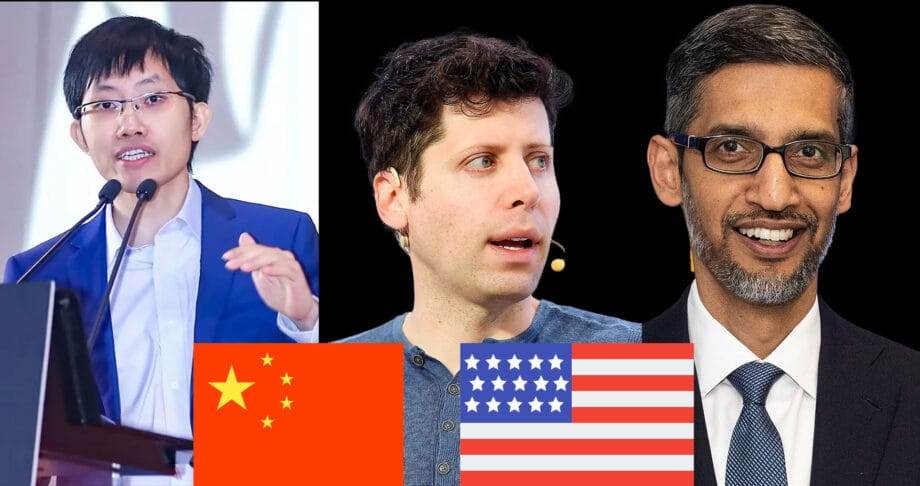
The US and China are the clear front-runners in the global AI race. The US leads in foundational research and private talent, while China excels at implementation and government support. Other key players like the UK and Canada are strong contenders in specific areas.
When you think about global technology leadership, AI is the new frontier. A country’s strength in artificial intelligence can shape its economic future and global influence. But figuring out who is “best” isn’t simple; it often depends on how you measure leadership.
The Two Superpowers: USA and China
The global AI landscape is mostly a two-horse race. The United States has a major advantage in its deep talent pool and massive private-sector investment from companies like Google, Microsoft, and NVIDIA. Its top universities drive foundational research that pushes the entire field forward.
China, on the other hand, leverages immense government support and has access to vast amounts of data. This combination allows it to deploy AI at a scale that’s difficult for others to match. The country focuses heavily on practical applications like facial recognition and smart cities.
The United Kingdom: A Research Powerhouse
The UK has carved out a niche as a leader in AI research. It’s home to some of the world’s top computer science programs and influential companies like DeepMind. London is a major hub for AI startups and investment, making the UK a critical player in Europe.
Canada: A Pioneer in Deep Learning
Canada’s influence comes from its foundational role in modern AI. Many of the pioneers of deep learning have strong ties to Canadian universities. This academic strength has created a thriving ecosystem for AI research and development that attracts top talent from around the world.
What Determines AI Leadership?
A few key factors separate the leaders from the pack. You need a strong pipeline of talent from universities and industry. You also need significant funding, both from private venture capital and government initiatives. Finally, access to large datasets and massive computing power is a major advantage for training new models.
Comparison Summary
| Country | Key Strength | Notable Companies/Institutions |
|---|---|---|
| USA | Foundational Research, Private Investment | Google, OpenAI, Stanford, MIT |
| China | Government Support, Data Access | Baidu, Alibaba, Tencent, Tsinghua University |
| UK | Academic Research, Startup Ecosystem | DeepMind, University of Cambridge |
| Canada | Deep Learning Expertise, Talent | Vector Institute, MILA, University of Toronto |
FAQ
How is AI leadership measured?
Researchers look at factors like the number of high-quality research papers, the amount of private and public investment, the number of AI startups, and the size of the available talent pool.
Why are data and computing power so important?
Modern AI models require huge amounts of data to learn patterns and powerful computer chips (GPUs) to process it all. Access to both gives a massive advantage.
Will one country dominate AI in the future?
A: It’s hard to say. While the US and China currently lead, AI technology is spreading quickly. International collaboration is also common, so the future might be more multi-polar than dominated by a single nation.